Change used to be something organizations braced for every few years. A restructuring here, a new strategy there. Companies would evolve in cycles of three to seven years, and leadership had time to plan, adjust, and recover. That era is now over since last decade, in case you have not noticed.
Over the past 5 years, the pace of change has compressed to roughly once a year.
And now, we are entering a period where meaningful uncertainty and instability arrive every one to three months. The question is no longer whether disruption will come but how quickly you can respond when it does repeatedly.
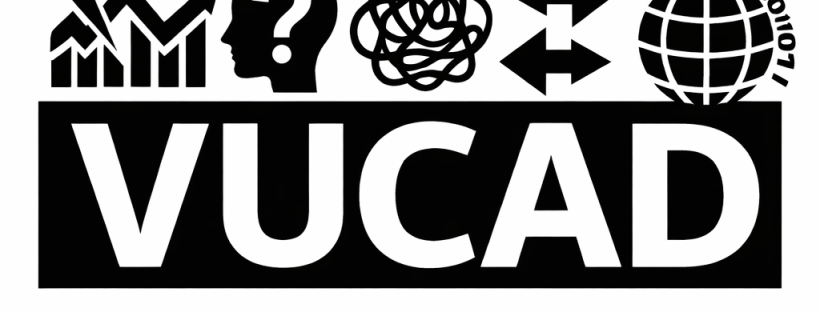
This is the world described by the VUCAD framework: Volatility, Uncertainty, Complexity, Ambiguity and Disruption. If you want to manage it, you need to understand both what goes wrong when key elements are missing and what strategic responses actually work.
The Five Challenges and Their Antidotes
Each letter in VUCAD names a distinct type of challenge, and each has a corresponding strategic response:
Volatility, meaning rapid, unstable, extreme shifts like market fluctuations or sudden policy changes. This is countered by Vision. When the ground is constantly shifting, a clear and compelling vision acts as a fixed point. It tells your team where you are headed, even when the path keeps changing.
Uncertainty, the inability to predict what comes next. This is met with Understanding. You build knowledge, invest in research, gather data, and listen to signals. You do not eliminate uncertainty, but you reduce what you do not know.
Complexity, the tangled, multilayered forces that make cause and effect hard to trace. This calls for Clarity. Simplify without oversimplifying. Break interconnected problems into components that people can actually work on.
Ambiguity, meaning unclear realities, mixed messages, and a lack of precedent. This demands Agility and Alignment. Move quickly. Make decisions with imperfect information. But also align your teams so that fast movement doesn’t mean fragmented movement.
Disruption, whether driven by technology, industry shifts, or evolving demographics. This requires Digital and Diverse Thinking. Integrate new technologies into the core strategy. Bring diverse perspectives to the table, because homogeneous teams tend to see disruption too late.
What Happens When Something Is Missing
The Knoster model for managing complex change offers a practical diagnostic. When all five elements: Vision, Skills, Incentives, Resources, and an Action Plan are in place, change succeeds. Remove any one element, and you get a predictable failure mode:
No Vision leads to Confusion. People work hard but pull in different directions.
No Skills leads to Anxiety. The team sees what needs to happen, but does not know how to do it.
No Incentives leads to Resistance. People understand the change but have no reason to embrace it. Fear is not enough of an incentive to move forward.
No Resources leads to Frustration. The will and capability may be there, but there is nothing to work with.
No Action Plan leads to False Starts. Energy and enthusiasm that go nowhere because there is no roadmap.
In a slow-moving world (let me know if you found one that will continue to exist), you could afford to discover these gaps over time and patch them. When change hits every few months, you can not. You need to diagnose which element is missing and fix it before the next wave arrives.
Managing VUCAD at Monthly Cadence
When instability is the norm and arrives at a pace measured in daily, weekly or monthly rather than years, principles become essential:
Treat the VUCAD responses as ongoing practices, not one-time exercises. Vision is not something you set once at an offsite. Understanding is not a single research phase. These need to be continuous, living activities embedded in how your organization operates week to week. Move quickly with a small team of leaders, not committees.
Run the Knoster diagnostic regularly. At the start of any change initiative, and honestly at any moment when momentum stalls, ask which element is missing. Is the team confused? You have a vision problem. Anxious? A skills problem. Resistant? An incentives problem. This framework turns vague organizational pain into specific, actionable gaps.
Build for speed without sacrificing alignment. The temptation in a fast-moving environment is to just move faster. But speed without alignment creates chaos. Agility means making good decisions quickly and ensuring people are moving in the same direction.
Invest in skills and resources proactively. When cycles were measured in years, you could train people and allocate resources reactively. At a monthly cadence, you need standing capacity, including cross-functional skills, flexible budgets, and on-demand resources, already in place before the next disruption hits.
Embrace diverse thinking as a strategic asset. The “D” in VUCAD is often the most underestimated. Disruption does not arrive with a label. Diverse teams, spanning background, discipline, and perspective, spot emerging threats and opportunities that homogeneous groups miss entirely. Not what we look like, but what we bring to the table and are ready to take action.
The Bottom Line
Uncertainty and instability are not bugs in the system. They are part of the system. Change is a norm; that is nothing new. The accelerating speed of change is newer factor. Get used to it. The companies that thrive won’t be the ones that eliminate VUCAD (that is not possible), but rather the ones that build the internal muscle to respond to it continuously. There are opportunities in any situation.
Be ready to move or get out of the way. You can be quicker than your competitors. Reacting faster can be a competitive advantage, as it counters delays, doubt, fear, and indecisiveness.
Vision. Understanding. Clarity. Agility. Diverse Thinking. Skills. Incentives. Resources. Action Plans.
None of these are optional anymore. And none of them are one-and-done. In a world where the next disruption is less than a month away, managing VUCAD is part of daily expectations. Are you ready for more rapid change in this VUCAD world?
If your leadership team is still operating with yesterday’s assumptions about change, you are already behind. VUCAD is not a theory. It is the environment you are leading in right now. The real question is whether your organization is equipped to respond with speed, clarity, and confidence.
If you want to strengthen leadership alignment, accelerate decision-making, and build true resilience at the executive level, let’s talk. Schedule a leadership strategy call to assess how prepared you are for sustained disruption and what to do next.
 Henrik de Gyor